
Snow day!
On negative capability...

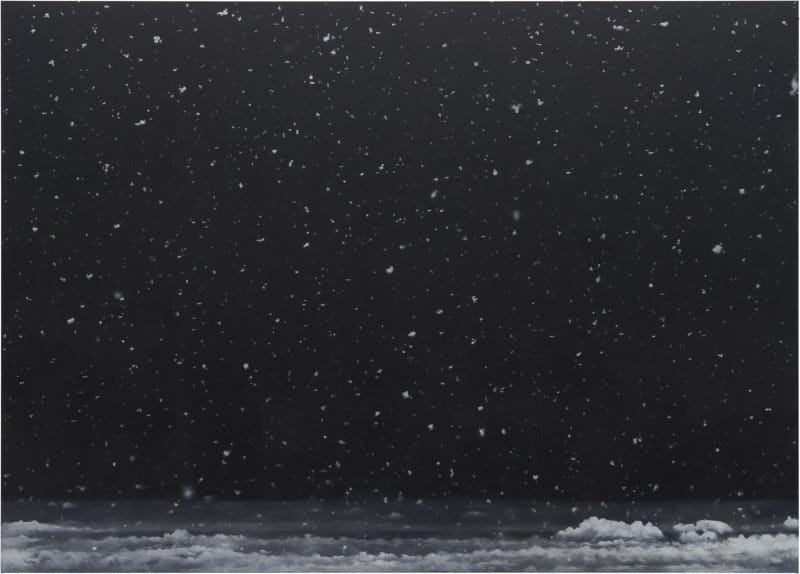
Snow drifts. Flakes so fine that I can only focus my eyes on a cluster at a time, though I catch soft blobs floating down from tattered leaves in my periphery. The neon of the block catches on the snow’s white against the dark sky, and in the brief moments where the regular accelerating gust is silenced, their slow drift appears gravitational, like stars. I take a step closer, and suddenly they melt and cure with brushy fixedness onto the canvas in front of me.
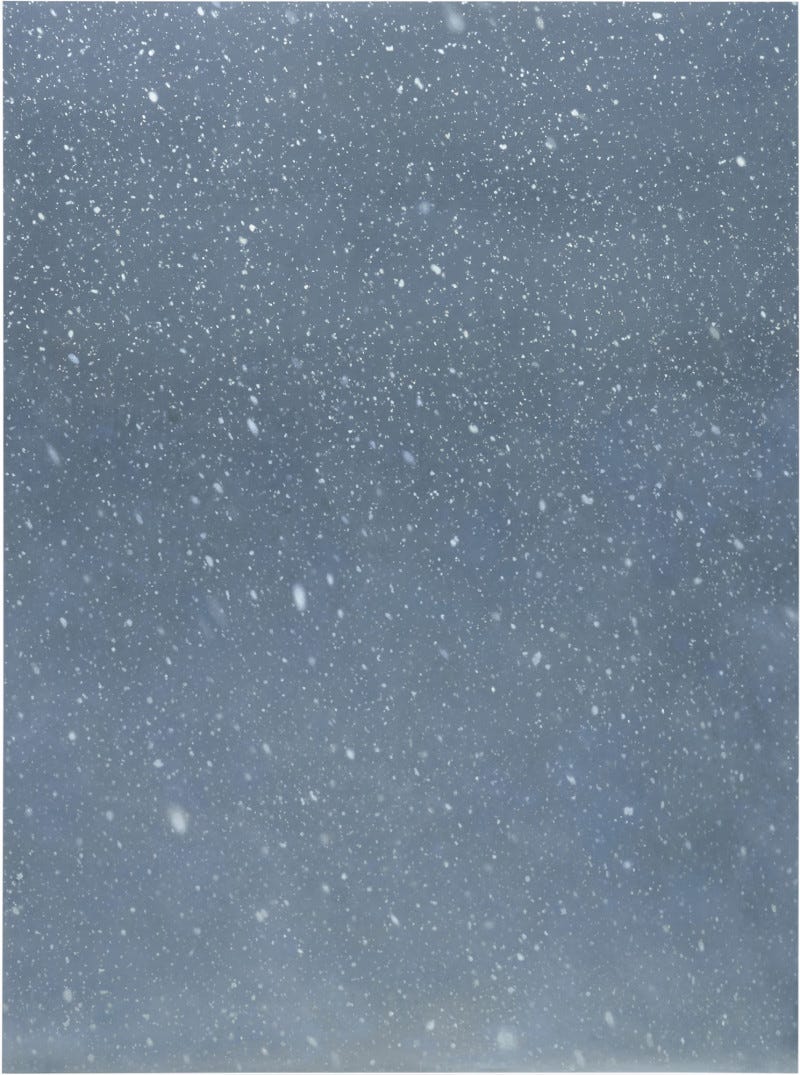
On this wintry day, this view seems to follow me – on the homey stretch of 32nd St between Broadway and 6th, outside the gallery windows, inside the gallery walls next door where they’re showing the paintings of Vija Celmins. She’s known for her teetering between hyperrealism and abstraction, dynamism and fixedness, recognition and alienation. The splotches that she dots and swoops in white paint contain oceans, snow, stars. You see ‘em all; they oscillate and dodge your determination to determine them. They’re breathtaking, and all for their uncertainty.
***
I stared at the ship’s wake, steps thumping as I ran on the treadmill. The gym was on one of the higher floors of the cruise, right at the bow, surrounded by glass walls facing the water. I wish I ran more than I do; it’s either an unfortunate bout of anxious restlessness or an excessively comfortable gap in a deep set routine that ties up the laces of my running shoes. This instance was the former. I ran to the beat of my tired playlist, mesmerized by the rhythmic peaking and breaking of the water.
This week-long Christmas cruise, planned by my grandmother, was meant to be a joyous force of closeness and family bonding, yet I found myself shrouded by the stresses of the upcoming semester. It would be my last, and I found the pressures of the season to be nearly unbearable. We were on open waters for five of the seven days, waters deceptively battering, as their superficial calm was more an illusion afforded from our great heights above the surface than true stillness. Waves shrunk to specks, pixels amongst a blanket of evenness. Only a couple hours passed before we consciously felt them beneath us, somehow rocking a boat fortified by the weight of thousands of travelers and employees. I occasionally had to grip the safety rails to steady myself on my flat, stationary run. I still ran, though, to try to clear my mind. And as I battled my angst on the treadmill, the impending thesis deadline, graduation sans employment, and global dispersal of friends and loved ones buffeted my mind’s helm, even when fortified by the constant company of my beloved family.
It was a strange encounter with a new fear – claustrophobic in the present, afraid of the vast and unforgiving future, with no land or grounded horizon in sight. 40 pages of thesis left to write, a mind that can only produce a single word, sentence at a time. Tightness in the chest, short breaths. Control over my own relocation, but only as far as potential jobs allow. Zero control over my friends’ relocation, the people I grew accustomed to living with for the past five years. Work, meaning, luck, the grind. Loss of expectations lent cruel hypotheticals to the imaginative. What if land is never in sight? What if, beyond all this open sea, is only more sea? What if I am bound to a life of running on this treadmill, panting as I futilely try to find a glimmer of life in the wake or lump of land in the horizon?
Silly questions given my place and privilege, I know. The course of this cruise had been long charted – I knew exactly when we would get to spend a few hours washed up on the beach; we’ve had plans to get soondubu as soon as we dock long before we ever departed. And I’m lucky enough to never be alone – I have relationships that distance could never diminish. A couple hours chopping it up with my sisters is the easiest proof of that. Graduating with a college degree is hardly a freefall into the void, and I always planned to move to NYC, a city “basic” and notorious for its disproportionate draw of recent grads. And still, this fear of unknowing had taken deep root; worrisome questions had months to inch towards absurd severity. Anticipation of change overtook me in ways far more uncomfortable than the change itself.
***
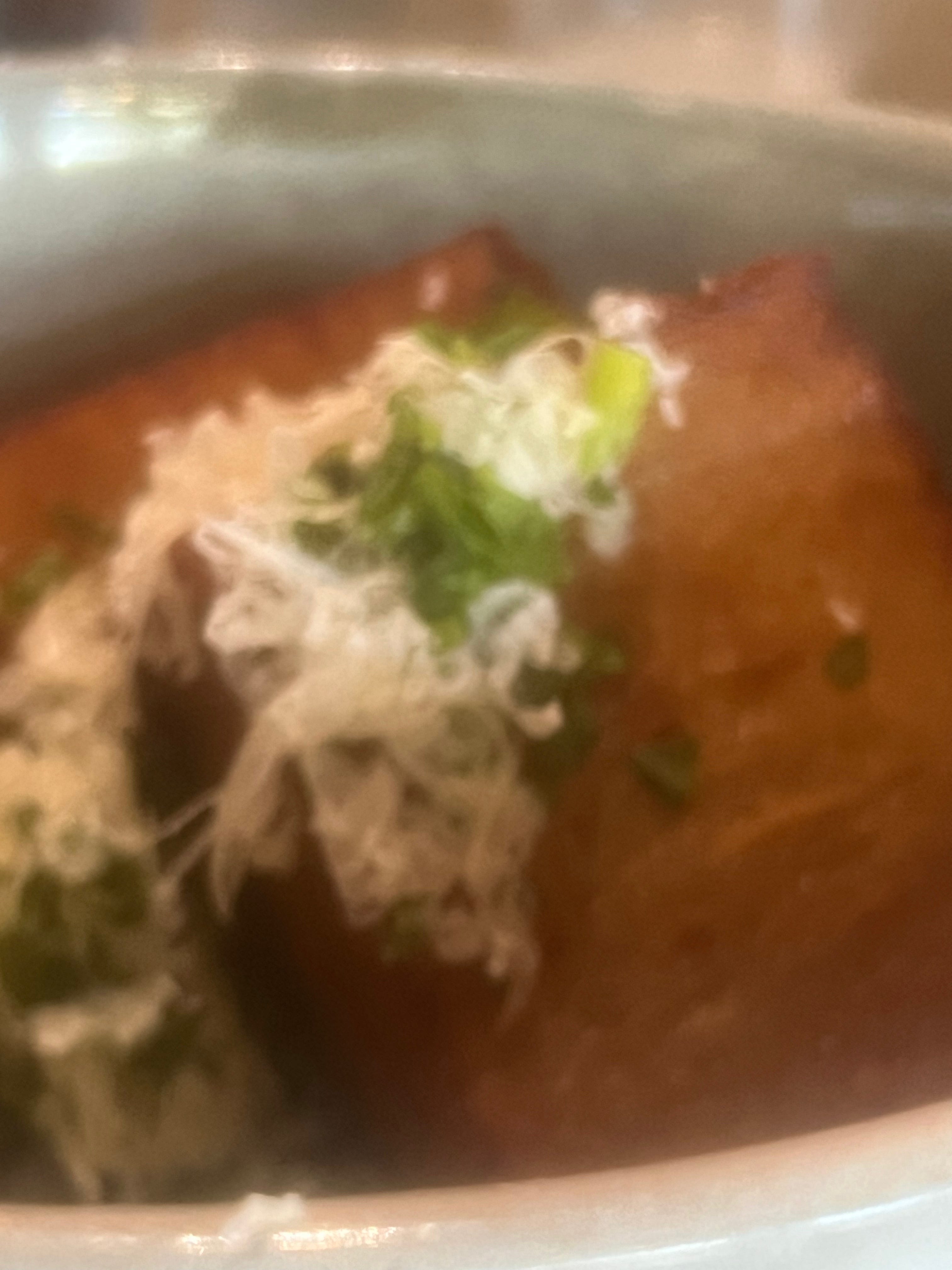
I was walking Juno after coming home from work not too long ago, when I shattered one of the camera lenses on my phone – such a nuisance. Now, every time I reach to take a photo of a delectable bite, it looks like it has been smeared with a cloud of grease. I can zoom my camera out to engage the lenses in a way that avoids the hazy fog of the shatter, but I don’t always want the fisheye distortion. The bulk of my photos – food pics and artwork close ups – are not well suited to this new effect. I often scroll through my camera roll when I sit down to write to reaccess these sensory experiences. It’s a far more robust web of past events than my fickle memory, a reliable well of inspiration. I worried for some time about how this minor inconvenience may affect my mediating of memory – heck, it was broke! I suppose capturing the past with a blur is much more true to life; it’s a much more accurate conveyance of my actual memory than a crisp hi-res photograph. One of the first pictures I took with the broken camera is of the most labor intensive hashbrown I’ve ever encountered, layered with paper thin sheets of potato and cut and fried into a crunchy slab, but reduced in future vision to an imperceptible haze. Still, I snapped the picture.
***
In the midst of the final, dreaded semester, I got lunch with a dear friend Carli. I’ve always admired her “glass-half-full” mentality. Her positivity, so I learned over this lunch, stems not from the cliche, but from nuanced poetics and an eye for the serendipitous (it should be noted that she runs an Instagram account called @lic3nse2post, where happenstance sightings of verbal expressivity through license plates serves as an endless source of utter delight). “Have you ever heard of ‘negative capability’?” I had not, but she quickly rattled off the essence of the concept with my full trust, as she was a student of comparative literature.
Coined by John Keats, negative capability was the very quality that he determined denotes an excellent writer:
“I had not a dispute but a disquisition with Dilke, on various subjects; several things dovetailed in my mind, & at once it struck me, what quality went to form a Man of Achievement especially in Literature & which Shakespeare possessed so enormously—I mean Negative Capability, that is when man is capable of being in uncertainties, Mysteries, doubts, without any irritable reaching after fact & reason—Coleridge, for instance, would let go by a fine isolated verisimilitude caught from the Penetralium of mystery, from being incapable of remaining content with half knowledge. This pursued through Volumes would perhaps take us no further than this, that with a great poet the sense of Beauty overcomes every other consideration, or rather obliterates all consideration.”
This is the only instance on record where Keats ever mentioned the term, in a letter to his brothers detailing the revelation that befell him after a conversation with dear friends and fellow writers, Charles Dilke and Charles Brown. I was so struck. The embrace of uncertainties, mysteries, doubts is not a relinquishment of curiosity and intellect, but a posture of humility and truth. It largely encapsulates the logic of my own spirituality – I am so easily exhausted by “irritable reaching.” I am stuck on the cruise ship, stuck with a broken camera lens, stuck in the present, and all that irritable reaching can accomplish is a tight chest and cruel questions. I longed to see my future with clarity, and its indistinguishable haze worked me into a state of fear and tiredness. Half knowledge was to me a reason to ache and overthink in attempts to fill in the blanks, but in Keats’s conception, it simply leaves room to embrace a sense of faith that refocuses your vision, that teeters on recognition and alienation, that is unexpectedly beautiful and thus more beautiful.
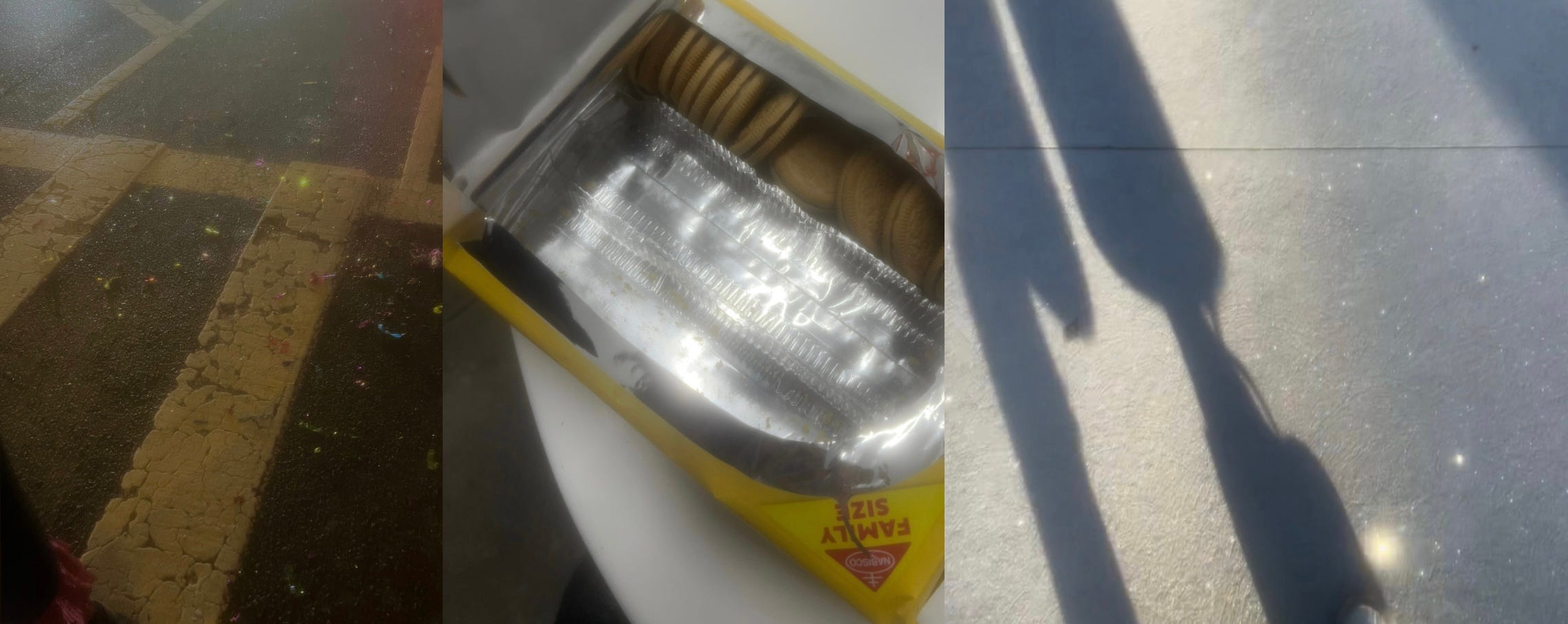
Curiosity kept me taking smudgy photographs, but negative capability leaned into the gleam of light that would newly appear thanks to the fog. A belated turn of my iPhone camera to the sun revealed an unexpected effect – any direct light now diffuses in a lovely haze, leaving a warm, ethereal residue over what would otherwise be a mechanically precise image. When showing some coworkers my photos from the past weekend, one joked that I’ll look back and reimagine these memories as the most romantic era of my life. A picture of a near empty oreo container made my mom question whether it was sculpture or real. I captured the confetti flattened on Chinatown streets after Lunar New Year like colorful gems. The leaves on the dead bushes along the Highline glittered with sunlight. I even pointed my camera to the ground and gasped, for in the bare sidewalk I could see a smattering of sparkling stars.
***
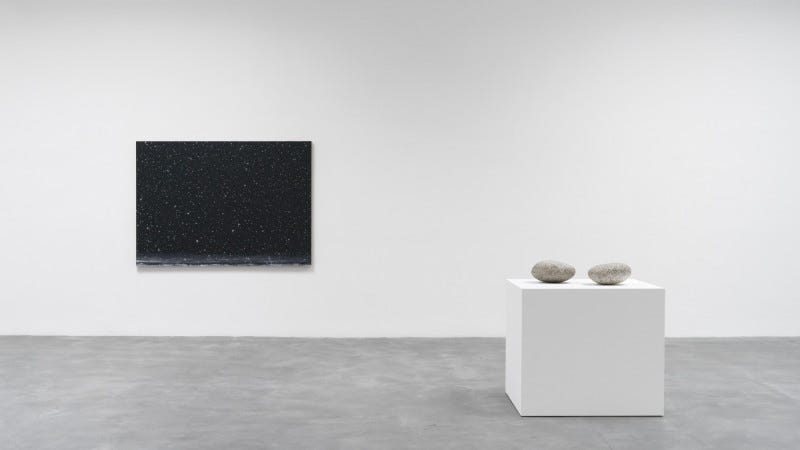
There are two round stones in the center of Celmins’s show. They are nearly identical, speckled with dots of onyx, a clay-like red, and cream. They are the same dimensions, smooth and rounded as though sanded down by time or water or wind. One of them, however, is fake. A facsimile of natural creation so close to the original that my friend and I bickered over which was which.
A painting, Snowfall #3, sits across from it, containing an expansive blackness that illuminates the starry white flecks of paint. They accumulate on the bottom in low sludgy mounds, mounds so uneven and foamy that I think they might be waves…
So honored to be a part of your story. Always with you through the uncertainty!!!!
Indelible